True Course Simulations builds VR and Mixed Reality flight training devices paired with patented in-headset courseware. Used by the U.S. Air Force Academy, Embry-Riddle, and a growing list of independent schools — engineered to reduce flight hours and accelerate mastery.
Twenty years in the Canadian Air Force, then twenty more on faculty at Embry-Riddle. Raynald Bedard knows how pilots learn — and where flight training breaks down.
True Course Simulations was founded in 2011 by Raynald Bedard, who spent two decades as a Canadian Air Force pilot before joining Embry-Riddle Aeronautical University as a faculty member and advisor. He started TCS after retiring from ERAU, with a thesis that has guided the company ever since: simulators don't replace airplanes, but pair them properly and students learn faster, safer, and more affordably than either tool can manage alone.
Today the company operates from a modest workshop at 430 N Mt Vernon Ave in Prescott, Arizona, with a team of six full-time employees in-house and two more embedded as instructors at the U.S. Air Force Academy. CEO and co-owner Brett Watts, an Embry-Riddle graduate, leads day-to-day operations. AJ Smith heads sales. Every TCS unit is designed and built in Prescott — the company markets itself, accurately, as "proudly designed and built by veterans in Prescott, Arizona, USA."
What began as a small contract shop has grown into a manufacturer with installations on five continents. The U.S. Air Force Academy operates 40 of their simulators. Embry-Riddle's Daytona Beach campus runs them across multiple training programs. UNSW School of Aviation in Sydney, Nelson Aviation College in New Zealand, and the Flight Simulation Technique Centre in India all use them in ab initio training. Independent flight schools like In The Pattern run them as part of their primary training fleet — and TCS systems are now deployed at 20+ high schools nationwide, delivering full aviation pathway programs to students who have never sat in a real cockpit.
True Course Simulations has earned institutional trust across independent flight schools, military, university, high school, and career technical education settings.
Every TCS device is a motion-actuated cockpit with pro-grade controls and an immersive headset. What changes is the airframe it emulates — and the headset technology behind it.
TCS ships two complete training systems. Both share the same core architecture: a steel-frame seat box with D-BOX haptic motion actuation (pitch, roll, yaw — with hand-coded flight sensations), an adjustable sliding seat, professional-grade controls including yoke or stick, rudder pedals, throttle quadrant, and switch panels, plus a high-resolution headset. What changes between the two systems is the headset technology and the level of cockpit fidelity it makes possible.
The foundational TCS platform. A Cessna 172-configured cockpit with full motion, a high-resolution VR headset, and integrated Virtual Flight Instructor courseware. Best fit for ab initio flight schools, high school aviation labs, and STEM programs — anywhere standardized primary training matters more than glass-cockpit fidelity.
The advanced TCS platform. Combines a physical cockpit with a mixed reality headset that blends real instruments and a virtual outside world. Designed for universities, military programs, and career technical education centers — anywhere procedural fidelity and physical interaction with avionics matter. Fighter-style side-stick configuration available.
A simulator without good courseware is just expensive scenery. TCS's edge is what runs inside the headset — and the discipline of pairing hardware, software, and instructional design as a single system.
Most simulator vendors sell hardware and let the customer figure out curriculum. TCS ships a structured Read → Watch → Do learning loop with 70+ lessons across 7 modules, built into the device. Students advance only after demonstrating mastery.
The standardized courseware means a school can run aviation training without a pilot on staff. That's the unlock for STEM programs, recruitment-constrained Part 141 schools, and any operator hitting an instructor-capacity wall.
An Embry-Riddle study published in 2022 measured a 30% reduction in time-to-solo when TCS's VR system was paired with traditional flight training. Not a marketing claim — a published result from one of aviation's most credible research institutions.
Designed and assembled in Prescott, Arizona by a small veteran-led team. Every install is on-site, including hands-on customer training. Comprehensive warranty, remote troubleshooting, and a support team that knows every unit by serial number.
Every session is recorded and analyzed. Students see objective feedback on their performance; instructors see exactly where each student is improving and where they're stuck. For accreditors and grant reviewers, the data is the report.
The VR Immersive Training Device ($48K) is the foundational platform. The Mixed Reality system ($92K) is the advanced one. Both share the same cockpit architecture, courseware framework, and support infrastructure — and both can be configured for Cessna 172, Diamond DA40, or fighter-style cockpits. Start with one, scale into others.
Simulation isn't meant to replace real airplanes. You must combine simulators and airplanes together for the things each of them is good at.— Raynald Bedard, Founder · True Course Simulations
The courseware is the part most schools end up valuing most. It's also what's hardest to copy.
The Virtual Flight Instructor is TCS's patented in-headset learning system — a structured curriculum that walks every student through the same maneuvers in the same sequence, with the same standards. The pedagogy is deliberately simple: Read a short pre-flight briefing covering the essence of the lesson; Watch the maneuver demonstrated correctly; Do the maneuver yourself, with real-time feedback and the ability to repeat until mastered.
There are 70 lessons across 7 modules, ranging from basic ground reference maneuvers (rectangular courses, S-turns, turns around a point) through stalls, traffic patterns, emergency procedures, and IFR approaches. Each lesson tracks the student's performance against published standards. The system records every session, so a CFI can review exactly what happened and where to focus the next flight lesson.
This is the part of the product that's hard to replicate with consumer VR. Headsets and software exist; structured aviation curriculum delivered inside the headset, validated by years of academy and university use, is something else entirely.
The buyer base is more varied than most simulator vendors. Each segment uses the system differently — and each gets a Skyfarer-referred 3% discount.
Owner-operated Part 61 and Part 141 schools squeezed between instructor shortages, fleet utilization, and competitive pressure from larger academies.
If you're running 5–30 aircraft and watching CFIs leave for the airlines as fast as you can hire them, every hour a CFI spends on a chair-flying briefing or basic procedural drilling is an hour they're not generating revenue at the controls.
For independent schools, TCS lands as both a CFI multiplier and a competitive differentiator. A student can complete structured procedural training between flight lessons without an instructor in the room. The school can advertise it as a feature ("VR-equipped flight training"). And in markets where larger academies are pulling students with marketing budgets, having modern training tech on the wall changes the comparison.
At $30/hr sim time billed and 4 students per day, a single VR unit pays back in roughly 18 months at current utilization patterns. Add Section 179 in year of purchase and the payback compresses further. Skyfarer-referred schools receive 3% off list pricing.
Sherman Gardner CEO · In The Pattern, TXShoutout to True Course Simulations for developing a virtual reality training tool that enhances and complements our Private Pilot program. ITP students are working through the full Private Pilot VR simulator course — taking them from first flight prep all the way to check-ride readiness.
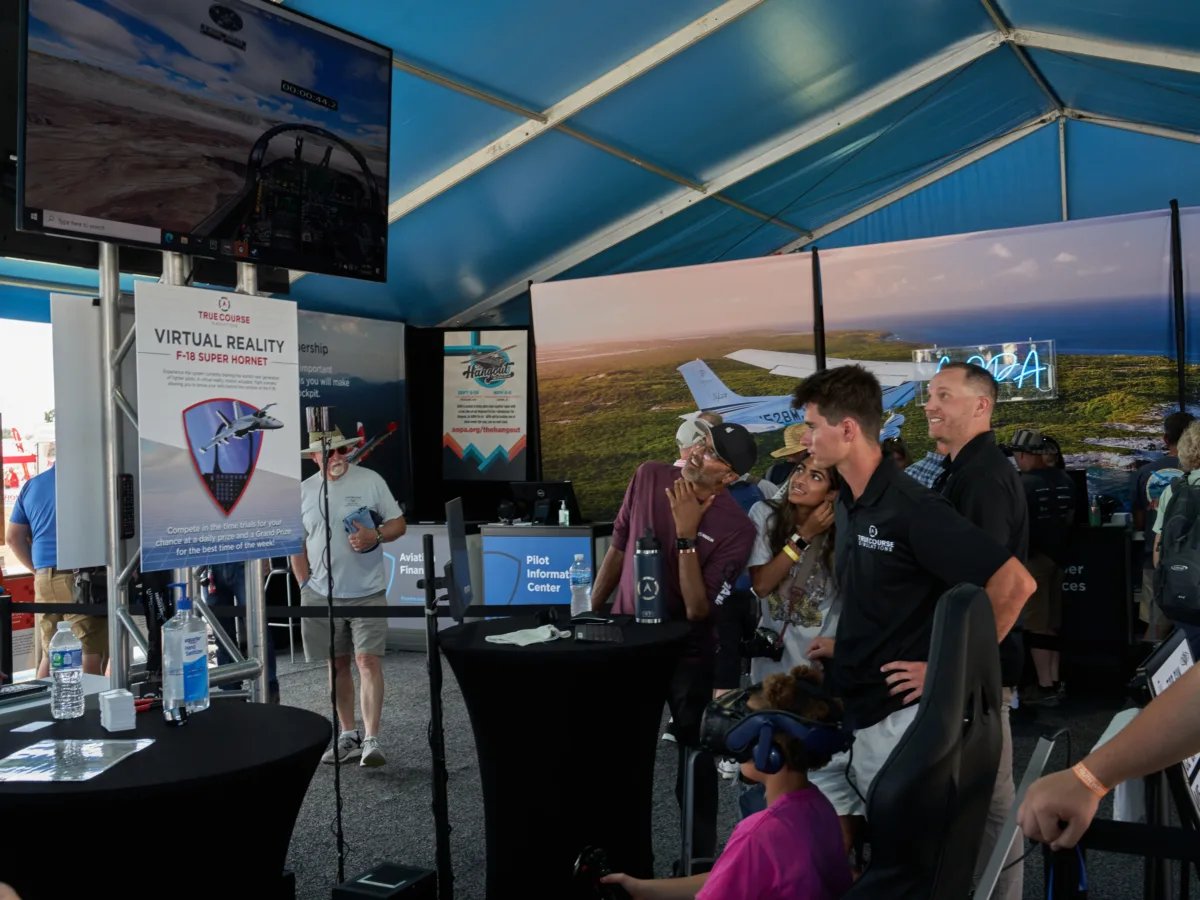
This virtual reality experience puts students in a fully immersive environment, guided by a virtual instructor through every lesson. The monitors above display exactly what the student sees inside the headset, giving instructors and spectators real-time insight into their perspective.
It's proving to accelerate solo timelines, shorten check-ride prep, and reduce overall training costs. This system is a powerful springboard for future pilots.
High schools and career-technical programs building aviation pathways — where the unique unlock is that no one on staff needs to be a pilot.
This is the segment where TCS's product architecture matters most. The patented Virtual Flight Instructor courseware delivers structured, FAA-aligned aviation instruction without requiring a CFI in the room — which means a CTE director, a STEM coordinator, or an aviation pathway lead can run a credible aviation program even with no pilots on the faculty. TCS has deployed at 20+ high schools nationwide on exactly this premise.
Aviation pathway programs are also one of the most fundable initiatives in K–12 right now. The pilot shortage has put aviation on the radar of state workforce boards, federal CTE funding streams, and private aerospace foundations — and TCS's deployments tend to qualify across most of them.
Most K–12 aviation programs are not funded out of operating budget. Funding comes from grants and dedicated CTE / workforce streams — and TCS's deployments tend to qualify across most of them:
TCS supports schools with grant writing. They've helped enough programs apply that they have working language for Perkins V applications, state aviation board submissions, and Choose Aerospace grants. For schools without grant-writing experience, this is often the difference between a program getting funded and not.
TCS team can talk through school budget cycles, grant timing, and CTE pathway structure without a translation layer. TCS's team handles the on-site demo (about 100,000 miles a year of travel), and they can help with grant-writing collaboration. Skyfarer-referred schools receive 3% off list pricing.
Don Culp The Challenger Learning Center · Richland County School District One, SCWe've been fortunate to have one of these cutting-edge simulators at our training center. The integration of Virtual Reality and motion technology is truly a game changer for flight training.
This simulator enhances pilot proficiency, fosters positive habit transfer to real-world flying, and provides immediate, structured feedback through its lesson design.
While traditional options range from basic desktop simulators to full-motion Level D systems, True Course Simulations has developed a solution that, in my opinion, surpasses both — and everything in between — in terms of effectiveness and versatility.
University departments running ATP-track programs, where weather days and aircraft availability quietly drag every student's progression by months.
Most collegiate programs already have at least one Frasca or Redbird FTD. Loggable AATD time gets booked solid, and there's nothing for the rest of the curriculum — primary maneuvers, ground reference, traffic patterns, emergency procedures — to land between flight lessons.
That's where TCS lands. Not as a Frasca replacement, but as procedural training infrastructure that lets a student show up to a dual lesson having already practiced the maneuver fifty times. Embry-Riddle's published research showed a 30% reduction in time-to-solo when their VR system was paired with traditional flight training.
TCS travels for qualified prospects — about 100,000 miles a year of demo visits. Expect an initial Zoom call to talk through your program, followed by an on-site visit if it's the right fit. Skyfarer-referred schools receive 3% off list pricing.
Aviation businesses selling services around training — checkride prep, recurrent training, type-specific orientation — where a sim becomes a new revenue line that doesn't require adding aircraft.
If you're already selling services to pilots, the question is whether to add simulator-based offerings to the menu. TCS lets you say yes without adding fleet, hangar space, or insurance.
The economics work differently than they do for flight schools. Where schools sell sim time to their existing student base, service providers often sell to a much wider audience — recurrent training for owner-operators, type-specific checkride prep, BFR practice, IPC scenarios. The unit isn't supporting a curriculum; it's supporting a service offering, and utilization can be aggressive (4–8 hours/day at well-marketed operators).
This segment moves fast — TCS knows the operational questions to expect (utilization, pricing, instructor inclusion, customer-facing positioning). Most demos are scheduled within two weeks of first contact. Skyfarer-referred operators receive 3% off list pricing.
True Course Simulations founded in Prescott, Arizona by Raynald Bedard, drawing on two decades in the Canadian Air Force and twenty years of faculty experience at Embry-Riddle.
First contract signed with the U.S. Air Force Academy. The relationship that anchors the company's enterprise reputation begins here.
Embry-Riddle Aeronautical University publishes research showing a 30% reduction in time-to-solo when TCS VR systems are paired with traditional flight training.
Featured on NBC News for the company's role in addressing the global pilot shortage through immersive training. International expansion accelerates with installations in India, Australia, and New Zealand.
Mixed Reality Immersive Training Device debuts at Oshkosh EAA AirVenture, drawing some of the largest crowds at the booth. Partnership with Aircraft Owners and Pilots Association formalized.
Expanded contract with the U.S. Air Force Academy supporting 40 simulators, valued "comfortably over a million dollars." Installations grow at university and STEM customers in the U.S. and abroad.
It depends on whether the specific TCS device the school operates holds an FAA Letter of Authorization (LOA) as an approved Aviation Training Device (ATD). Without an LOA, simulator time cannot be logged toward certificate or rating requirements — though it remains extremely valuable for building procedural skills, cockpit familiarity, and reducing overall training time in the aircraft. If a school is considering using TCS time toward loggable hours, it's worth confirming with TCS directly whether the specific device configuration holds a current BATD or AATD LOA, and verifying the authorized uses listed in that letter.
Both the VR ($48,000) and MR ($92,000) systems ship complete: the motion-actuated cockpit with pro-grade controls, D-BOX haptic actuators, the headset (VR or Mixed Reality), the full Virtual Flight Instructor courseware (70+ structured lessons), LMS backend with session recording and performance analytics, in-person installation, customer training, comprehensive warranty, and ongoing remote support.
Schools and operators referred through Skyfarer receive a 3% discount on list price. Just request a quote through this page or mention Skyfarer when contacting TCS directly — the discount is applied at the order stage. No code, no expiration.
Not for the self-paced courseware. The Virtual Flight Instructor lets students work through 70+ lessons independently, with no instructor present — which is the unlock for STEM programs and recruitment-constrained schools. However, if a school wants to use simulator sessions toward loggable instrument time or other FAA credit, an authorized CFI or CFII must be present and sign the logbook entry. That's an FAA requirement that applies to all ATDs, not a TCS-specific rule.
Each unit has roughly the footprint of a large rectangular table — compact enough to fit in a typical classroom or briefing room. Power is standard 110V. TCS provides full site requirements at the quote stage.
Installation is white-glove and on-site. The TCS team ships the unit, installs it, trains your team, and hands you the keys. Most installations are completed in a day. No IT staff required.
Yes. TCS offers custom content creation for schools that want specific maneuvers, procedures, or scenarios beyond the standard 70-lesson library. Discuss scope and cost directly with TCS at the quote stage.
Yes — TCS has partnerships with equipment financing providers. The Skyfarer-referred 3% discount stacks with whatever financing terms apply. AJ Smith at TCS can walk through the options during your demo call.
The TCS system goes beyond simple gaming — it's a powerful, immersive educational tool that gives students a structured and engaging way to learn:
VR fully immerses the student in a virtual cockpit and outside world — best for ab initio stick-and-rudder fundamentals and procedural muscle memory. MR uses pass-through cameras to keep the physical cockpit (including a functional G1000) visible while overlaying a virtual outside world — best for IFR training and glass-cockpit transitions where physical interaction with avionics matters.
U.S. Air Force Academy (40 units), Embry-Riddle Aeronautical University, Massey University School of Aviation (New Zealand), UNSW School of Aviation (Sydney), FSTC in India, Liberty Creek High School (Tennessee), and a growing list of independent flight schools. TCS publishes a customer map at tcsims.com/map.
Yes — significantly. The primary value of the TCS system is not logbook credit; it's the reduction in wasted time and cost in the aircraft. A student who arrives at their first dual lesson having practiced checklists, cockpit flows, basic maneuvers, and radio calls in a simulator is a fundamentally different student than one who has not.
Embry-Riddle Aeronautical University found that students using the TCS learning system reduced their time to solo by 30%. That outcome doesn't require the simulator to be FAA-approved — it comes from consistent, structured, self-paced practice before the student ever touches the aircraft controls.
Think of non-loggable simulation time the way you think of chair flying, ground school, or studying approach plates: it doesn't go in the logbook, but it absolutely goes into the cockpit.
A 20-minute demo is the fastest way to evaluate fit. We'll connect you directly with AJ Smith at TCS, with full context on your program and the Skyfarer 3% discount applied.
Skyfarer-referred schools receive a 3% discount on TCS list price.